Within greater Adelaide, Kensington is a unique and historic South Australian village suburb. Some of our buildings date back to 1839.
Owning a heritage building is to be a part of this rich history, but navigating what you can do and not do by way of improving it can be an overwhelming and confusing journey! In general, demolition of most categories of heritage building is unlikely to be approved, but sympathetic renovations may be possible. The Kensington Residents Association has a number of members who are proud to be the custodians of a historic Kensington building. Each has had to come to grips with a confusing set of design and planning regulations when it comes to renovation or improvements.
Before you submit a Development Application to Council:
• For advice of a general nature or to chat to a homeowner with personal experience, you can email our secretary at contact@kra.org.au. We may be able to put you in touch.
• Talk to the Heritage Advisory Service at The City of Norwood, Payneham and St Peters as a useful first step
• Consider engaging an architect with an understanding of heritage regulations as a smoother way to achieve your aims.
Levels of Heritage protection (the confusing bit)
Most of Kensington is covered by the Kensington 1 Historic Area Overlay (NPSP5). This Overlay applies additional policies to development applications to ensure the integrity and character of the area is not compromised through uncontrolled demolition and unsympathetic new development.
Many individual buildings in this Overlay are recognised as Representative Buildings with characteristics of importance. Click here to find out whether a particular property is a Representative Building following our guide to using SAPPA (below).
Some buildings in Kensington are listed on the South Australian Heritage Register as State Heritage Places as they satisfy criteria listed in the Heritage Places Act (1993). Click here to find out more about Kensington’s State Heritage Listed Places. Many other Kensington buildings are listed as Local Heritage Places as they satisfy criteria listed in the Planning, Development and Infrastructure Act (2016). These have heritage value because they play an important role in identifying and preserving the community’s collective identity.
Finally, the Heritage Adjacency Overlay applies to properties abutting a State or Local Heritage Place. New development adjacent to Heritage Places must support the heritage and cultural values of those Places.
Even if your Kensington property is not a Representative Building or a listed Heritage Place, certain development restrictions may apply due to the Historic Area Overlay.
Useful links:
SA Planning and Design Code.
City of Norwood Payneham & St Peters Heritage and Historic Area Protection in the Planning & Design Code Fact Sheet
City of Norwood Payneham & St Peters Heritage
Legislation: Heritage Places Act 1993; Planning, Development and Infrastructure Act 2016
Anita’s story. A case study.
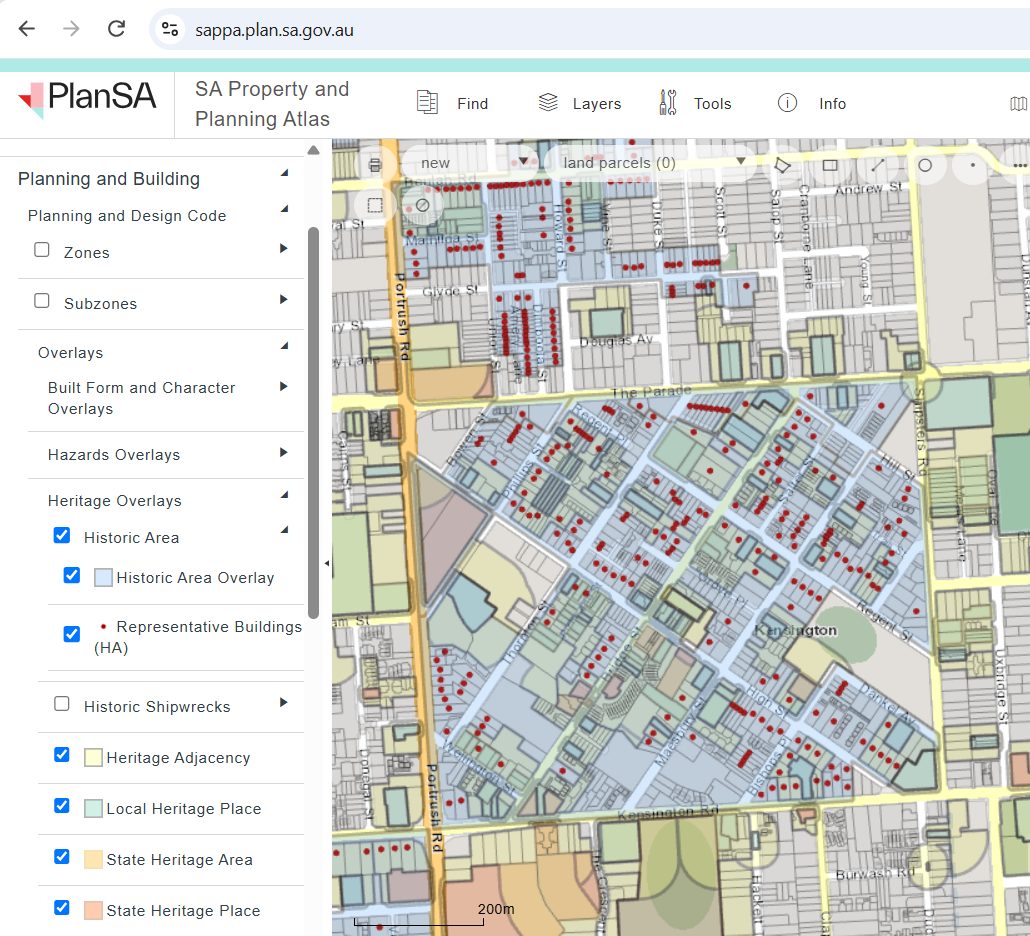
How to find out the heritage status of a property? Use the interactive SA Property & Planning Atlas or SAPPA (screenshot below).
- Go to https://sappa.plan.sa.gov.au/
- Click on ‘Layers’ on the top tool bar. When the Layers side bar opens, click on the triangle arrow beside ‘Planning and Building’ to open sub menus.
- Click on the ‘Planning and Design Code’ arrow, then the ‘Overlays’ arrow, then the ‘Heritage Overlays’ arrow.
- Arrow open ‘Historic Area’ and click the boxes to open the ‘Historic Area Overlay’ and ‘Representative Buildings (HA)’ layers.
Further down in ‘Heritage Overlays’ are the Heritage Adjacency, Local Heritage Place, and State Heritage layers.